Most natural stones interact with light. Onyx can transform it.
That single characteristic explains why illuminated onyx remains one of the most dramatic materials available to architects and interior designers.
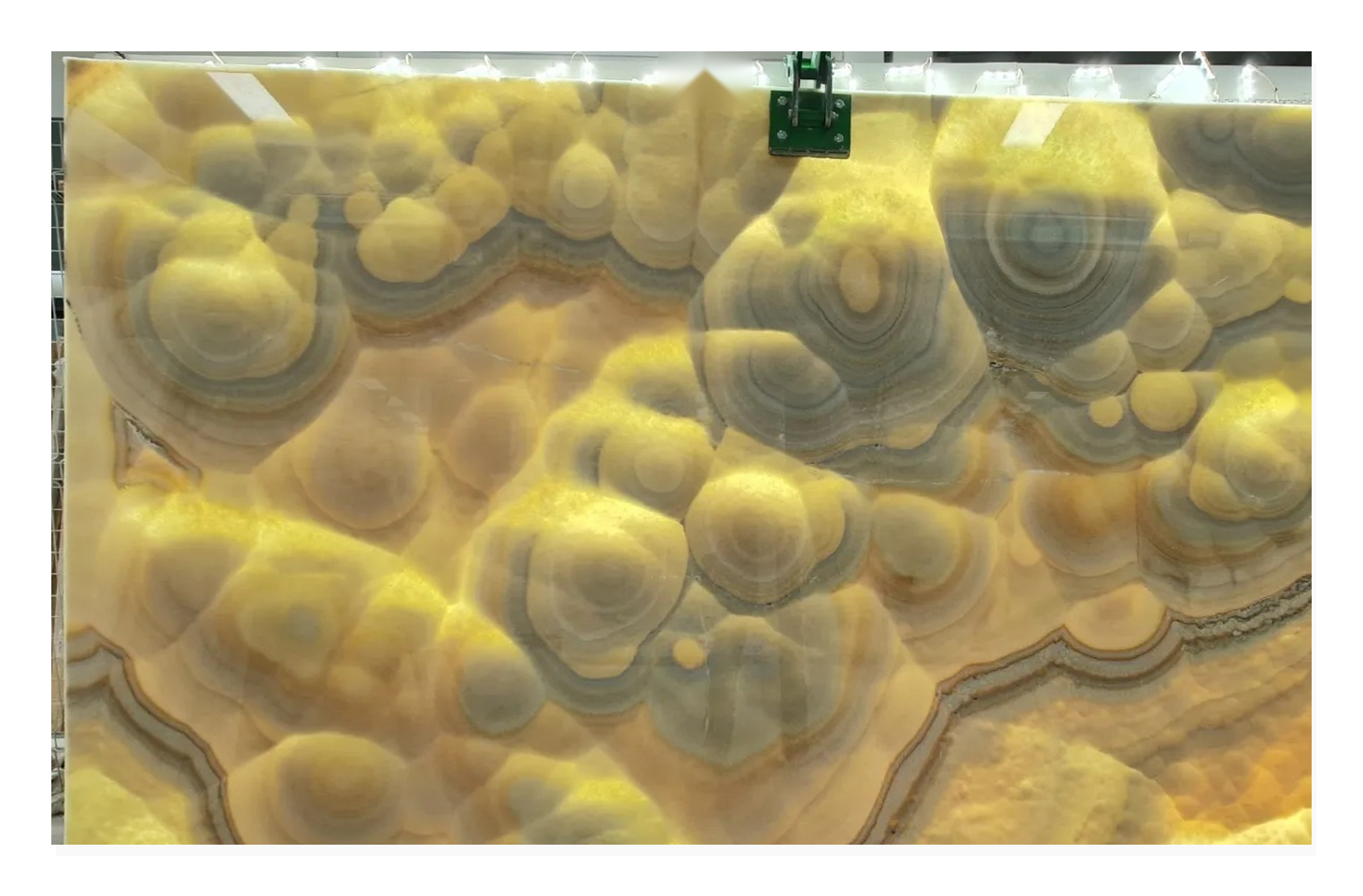
Without lighting, an onyx slab can already display complex layers of colour, clouds and mineral movement.
With correctly designed illumination behind it, the same surface can appear almost weightless. The stone becomes luminous.
Why Can Onyx Be Backlit?
Natural onyx used architecturally can contain translucent zones that allow light to travel through portions of the material.
The effect varies enormously from slab to slab.
Some sections may glow intensely. Others remain darker. Veins, mineral concentrations and changes in thickness can alter light transmission across a single slab.
That variation is not necessarily a problem. It is what creates depth.
Where Does Backlit Onyx Work Best?
Onyx should usually be used where people are meant to notice it.
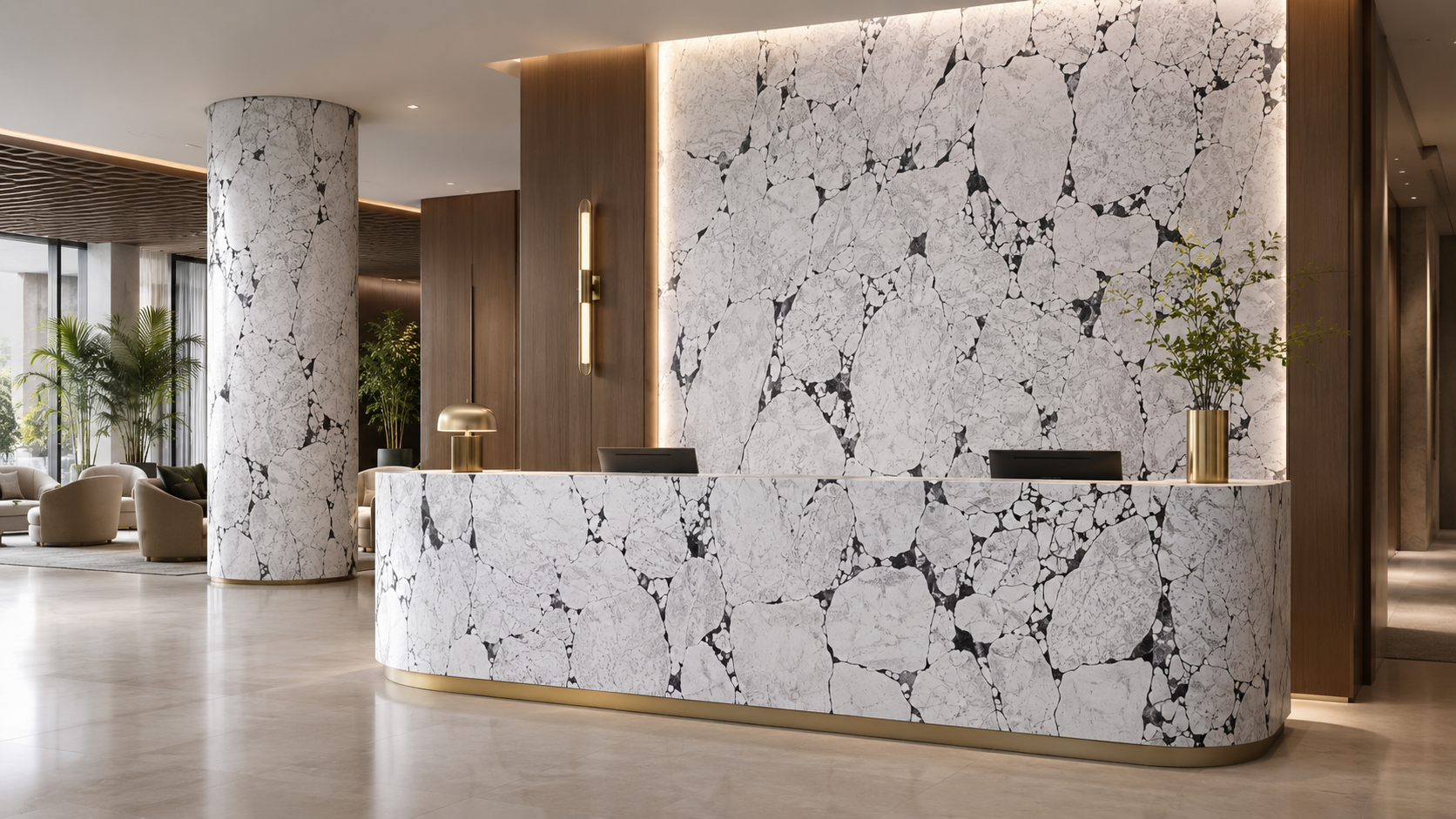
Hotel reception walls. Restaurant and cocktail bars. Luxury bathrooms. Spa entrances. Feature walls. Retail environments. Reception desks. Private dining rooms. Statement stair halls.
Its value is not simply the price of the stone. Its value comes from the experience it creates.
A relatively small illuminated onyx feature can sometimes have more visual impact than covering an entire room in a conventional surface.
The Most Important Decision Happens Before Lighting
The first step in a successful backlit project is not choosing an LED. It is choosing the slab.
A designer should assess the stone both illuminated and unilluminated whenever possible.
Why? Because the two appearances can be radically different.
Warm honey colours may intensify. Green mineral structures may become more visible. Previously subtle veins can become dominant. Areas that appeared similar under showroom lighting may transmit very different amounts of light.
For important installations, slab layout should therefore be designed before fabrication.
Think Beyond a Single Slab
Large installations introduce another challenge: continuity.
Imagine a hotel reception wall requiring six slabs. If the slabs are treated individually, every joint can interrupt the visual story.
Instead, the project should consider vein direction, colour transition, sequence of slabs and whether bookmatching or another slab-layout strategy is appropriate.
Bookmatching uses adjacent stone slabs to create mirrored patterns and is particularly effective when a material has strong directional movement.
With translucent stone, that composition becomes even more important because lighting can make the relationship between neighbouring slabs much more visible.
Lighting Temperature Changes the Stone
Backlighting is not neutral.
A warmer light source can intensify amber, beige, honey and gold tones. A cooler source can shift the perceived colour and emphasize other mineral structures.
Specialist discussions of illuminated onyx consequently focus not only on brightness but also on colour temperature and dimming.
This means architects should treat a physical mock-up as part of the design process whenever the installation is significant.
The question is not: “What colour is the onyx?” The better question is: “What colour will this onyx become under our lighting system?”
Avoid Visible LED Points
One of the quickest ways to make an expensive onyx installation look unsuccessful is uneven illumination.
Visible individual LED points, dark zones or shadows can destroy the illusion that the stone itself is glowing.
Successful systems usually rely on careful spacing, diffusion and sufficient distance between the lighting plane and the stone.
The exact construction varies according to the slab, supporting system and project conditions.
Lighting therefore needs to be coordinated with fabrication — not added after the stone has already been installed.
Maintenance Access Matters
Beautiful design must still be serviceable.
LED systems can eventually require maintenance. Drivers may need replacement. Electrical connections must remain accessible.
Designers should therefore consider how the lighting system can be reached without dismantling an entire stone installation.
The best detail is the one nobody notices until maintenance is required.
Backlit Onyx Should Not Look Like a Lightbox
Perhaps the most important design principle is restraint.
Illuminated onyx is already visually powerful. It does not need excessive decorative competition.
Timber, dark metal, bronze, plaster or very quiet adjacent surfaces can give the stone room to dominate.
The goal is not maximum brightness. The goal is depth.
When the light is balanced correctly, the viewer should first notice the stone — not the electrical system behind it.
Stone During the Day. Light After Dark.
One of the most fascinating qualities of onyx is that it effectively gives the designer two materials.
During the day it behaves like natural stone. At night it can become architectural illumination.
That dual identity is why backlit onyx remains so compelling.
It is not simply a decorative wall. It is a geological surface that changes with light.
Research References
- Fiorantina — Backlit stone in architecture and design
- Venezia Stone — Onyx with backlighting in interiors
- Stone Group — How to use book-matched slabs in interiors